 Release time:2026/04/03 13:59
  popularity:
  source:


by Liu Qiyu
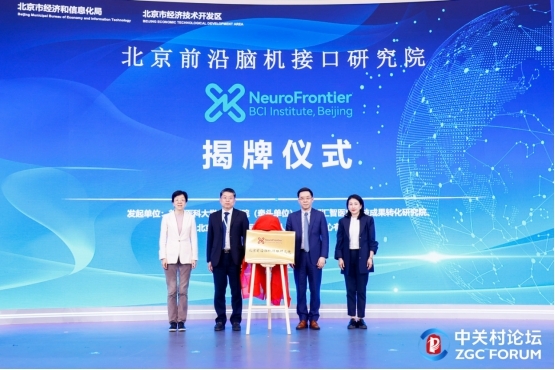
BEIJING, Mar. 30 (China Economic Net) - Beijing took a major step toward advancing brain-computer interface (BCI) technology on March 27, unveiling a new research institute, launching industry clusters, and rolling out policy support to accelerate commercialization.
At the Brain-Computer Interface Innovation Development Forum held on March 27 in Beijing, the NeuroFrontier BCI Institute, Beijing was officially inaugurated, with cooperation agreements signed with several companies to promote the commercialization of research. At the same time, plans for a Zhongguancun (Haidian) BCI industrial cluster were released, while districts including Changping and Beijing Economic-Technological Development Area (BDA) introduced supporting policies and development strategies, signaling the emergence of a multi-hub industrial ecosystem in the Chinese capital.
The forum also highlighted broader momentum in the sector. Ke Jixin, Vice Minister of Industry and Information Technology, described BCIs as entering a critical phase of transition from research to scaled-up application, calling for stronger efforts in core technology breakthroughs, practical use cases, and industry coordination.
Tomas Lamanauskas, Deputy Secretary-General of the International Telecommunication Union, said BCIs are moving from laboratory research toward real-world deployment, with strong potential in healthcare, accessibility, and education. He added that China is already at the forefront of innovation and industrial development in the field, with continued government support.
The forum also released 15 representative innovation outcomes, covering invasive and non-invasive BCI systems,neuromodulation devices, neural signal detection and analysis technologies. The developments target applications from treating neurological disorders and enabling stroke rehabilitation to sleep monitoring and industrial safety, with several already entering clinical or early-stage use. The developments underscore growing momentum in the BCI sector, particularly in areas such as medical rehabilitation and human-machine interaction.


 Telegram